

 Front Page
RESEARCH TOPICS
Automatic Essay Assessment
Concretizing Technologies in Special Education
Development Project for Technology Education
Information and Communication Technology for Development
Kids' Club
Mobile Learning
Seniors' Club
Software Visualization & Jeliot
Technologies for Children with Individual Needs
Text and Program Analysis
Virtual Studies of Computer Science
WHO & WHAT
News @ EdTech
People @ EdTech
Mémoire d'un Étudiant Français
Publications @ EdTech
IMPDET
University of Joensuu Department of Computer Science and Statistics @ University of Joensuu Academy of Finland European Commission European Social Fund TEKES - National Technology Agency of Finland SIGCSE - ACM Special Interest Group in Computer Science Education Assa Abloy Connexor Discendum Heureka Karjalainen Lingsoft Microsoft Nokia Sordino Information Systems
CONFERENCES, WORKSHOPS & SUMMER SCHOOLS
IEEE 4th International Workshop on Technology for Education in Developing Countries, July 10 -12, 2006, Iringa, Tanzania Malta International Summer School on Educational Technology in Cultural Context, June 20 - 25, 2005 Taiwan International Summer School on Educational Technology in Cultural Context, Taiwan, June 28 - July 3, 2005 International Conference on Educational Technology in Cultural Context, Taiwan, July 7, 2005 Mekrijärvi International Summer School on Educational Technology in Cultural Context, Finland, September 25 - 29, 2005 See more...

IMAGE PROCESSING ALGORITHM VISUALIZATIONS AND RESEARCH TOOLS
Java Tools for Image Analysis and Research
As a standard, research work in the field of image processing and compression includes lot of experimentation. New ideas shall be first implemented in some programming language or environment, and then undergo extensive empirical evaluation. Analysis of the weak sides will lead to a further research and development work. The implementation (programming of the developed method) process is usually a most time-consuming part of any research process. Therefore the flexibility of the implementation, such as code readability, fast modification ability, friendly programming environment, etc. are often prevail over the implementation efficiency, memory load and computation time. The efficient implementation could be often too expensive to conclude especially in the research process, when frequent algorithm modifications are required. However, the implementation efficiency shall not in any case be a down-side of the algorithm making it impossible to conduct in a reasonable time-frame or using sufficient hardware resources. Current work examines the usability of NIH ImageJ Java-based framework in the image processing research on example of implementing morphological operations. We demonstrate how the environment can be easily understood, and the new operations are implemented and modified by researchers familiar with basics of Java language. The set of morphological operators is implemented as a test task.
Advanced image-processing visualization and laboratory tool using Java technology
Development of Java applets used for demonstrations and experimentations in Image Processing courses. Teaching image processing is quite a challenging task. This might be the reason why image processing courses are in general of approbatur (graduate and postgraduate) level. According to teaching experience, an efficient teaching is feasible if a lot of attention is paid to the experimental work of the students. This experimental work shall be organized in a proper way to allow student put in practice and try out the studied technology in a short period of time during the course.
Better pedagogical results can be achieved if the visual tools for demonstration of basic aspects of image processing would be available to the teachers. Visualizing of the algorithm having impact on visual data (such as e.g. filtering algorithm) is superior to the plain textual description, requiring a lot of imagination. Tools can be used also by the students after lecture hours. In these laboratories, complementing the basic lectures, the students will actively process and manipulate images, and even construct own image processing tools within reasonable time frame. This hand-on experimentation will significantly facilitate learning of the mathematical concepts of image processing. In such a way better learning will benefit from experimentation. And, at last, the use Java platform makes these tools universally accessible.
Interactive Environment and Pedagogical Framework for Teaching and Study Digital Image Processing - The Improvizer project
Image processing is an of area of computer science whose popular is increasing. Its increasing popularity is due to the wide variety of uses for image processing. Powerful image processing algorithms are of high demand not only in fields such as medicine and robotics, they are even in demand by be producers of household goods. Because of the high requirements, in terms of mathematics, imagination and programming skills, that are needed to create such algorithms, it challenging task for educators to prepare specialists in the field of image processing. The complexity of image processing is one of the primary reasons why the subject is taught mostly at graduate or post-graduate levels, which prevents institutions to produce high amount of needed professionals.
The demand for IT tools that can be used in education is obvious. IT tools can offer highly illustrative and interactive environments, which are appropriate supplements to teaching in general. Although the benefits and advantages are clear, there is not any solution currently available that could aid the optimal in teaching and learning image processing. The proper learning process consists of two basic elements: abstract concept (the theoretical background) and experience. Unless both of these conditions are met, learning can not be successful. First, theoretical knowledge, the ground, is essential because we can't build on anything, unless it is strong and steady. To explain the theory of IP is very tricky since it demands high level of imagination on the part of students. At this point, it is good for a pedagogue be supported by a high-performance tool for the visualization of IP algorithms and for visualizing the impacts they have on images. Experimentation is another necessary condition in the teaching and learning process. Unless we pay sufficient attention to trial and practice, the learner understand what is being taught.
Our goal is to improve the teaching and learning of image processing. Our solution is to assist the teacher with a visualization and demonstration toolkit and to aid the student in the subsequent phase of cognition - the trial. We call this new concept of cognition Improvization, and integrate it into the pedagogical framework and the computer-based application suite - called Improvizer.
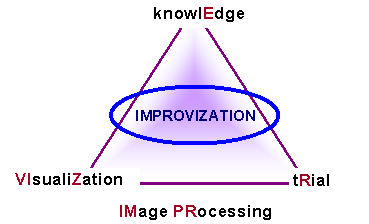
Improviser is targeted for the education community - universities and their students. Both parties should be able to afford the software and also execute it on a variety of computing platforms. We aim to create platform-independent, concise, license-free, and powerful education software that has a highly intuitive visual interface suited to the needs of teacher and learner.
Eugene Ageenko, Jan Bartusek, firstname.lastname@cs.joensuu.fi